
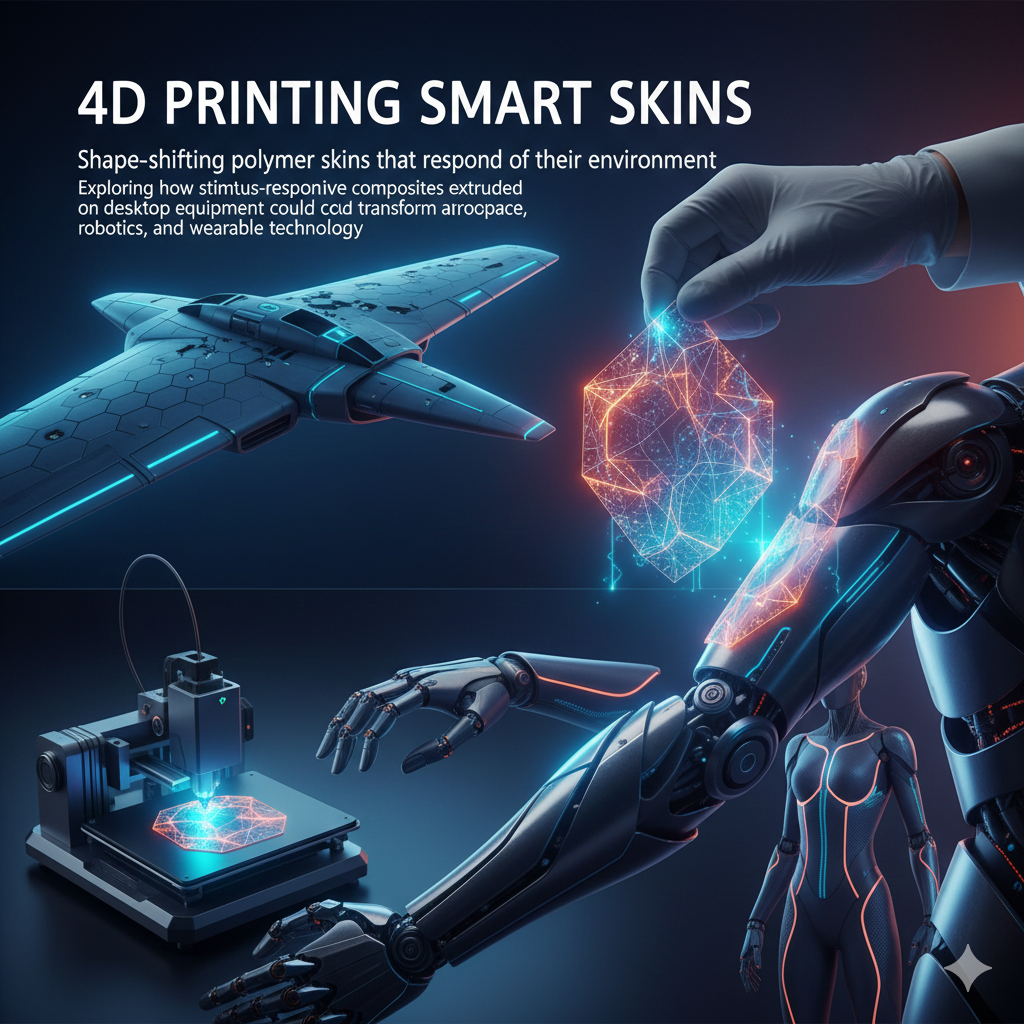
4D Printing Smart Skins
Shape-shifting polymer skins that respond to their environment — exploring how stimulus-responsive composites extruded on desktop equipment could transform aerospace, robotics, and wearable technology.
What Makes a Skin "Smart"?
In engineering terms, a "smart skin" is a surface material that actively responds to its environment — changing its geometry, stiffness, thermal properties, or electrical characteristics in response to external stimuli. The distinction from conventional surface materials is the same as the distinction between a thermostat and a wall: one monitors and responds, the other simply exists.
The concept has roots in biomimetics. Biological skins are remarkably capable adaptive surfaces — reptile scales that alter reflectivity with temperature, cephalopod chromatophores that respond to light and neural signals, human skin that varies its mechanical properties in response to hydration and temperature. The engineering challenge is to replicate this adaptive capability using materials and processes that are compatible with manufacturing at scale.
The Role of Stimulus-Responsive Polymers
Shape-memory polymers, hydrogels, liquid crystal elastomers, and piezoelectric composites all offer different pathways to adaptive surface behaviour. Each responds to different stimuli — temperature, moisture, light, mechanical strain, electric field — and each produces different kinds of responses: geometric change, stiffness variation, colour change, or electrical signal generation.
For aerospace and robotics applications, where the stimuli are typically mechanical and thermal and the required responses are geometric, shape-memory polymer systems are the most mature candidate technology. Their ability to undergo programmed geometric transitions in response to temperature changes makes them directly applicable to surfaces that need to adapt their aerodynamic profile, thermal management characteristics, or mechanical stiffness in operation.
From Filament to Functional Surface
The fabrication pathway that makes smart skins accessible at laboratory scale is desktop fused filament fabrication using custom stimulus-responsive filament. The geometry of the printed structure — its microarchitecture, layer orientation, and infill pattern — can be used to programme the direction and magnitude of the shape-change response, providing an additional design dimension beyond the material properties alone.
Producing this filament requires a desktop extruder capable of handling the specific processing demands of stimulus-responsive polymer systems. Many of these materials have narrow melt processing windows, are sensitive to thermal degradation, and may contain additives (liquid crystal mesogens, piezoelectric fillers, shape-memory crosslinkers) that affect melt rheology in ways that challenge open-loop extrusion systems. Precise, monitored extrusion conditions are not optional for this work.
Applications Under Investigation
The breadth of potential applications is genuinely unusual for a single enabling technology. Current research areas include:
- Aerospace: morphing wing surfaces that adapt aerodynamic profile in response to flight conditions, reducing drag across a wider operating envelope than fixed-geometry alternatives
- Robotics: adaptive grippers that modulate stiffness based on the compliance of the target object, achieving reliable manipulation without active sensing and control
- Wearable technology: garment structures that modulate thermal properties or compression in response to body temperature or movement, with applications in both performance sports and medical wearables
- Architecture: building facade elements that regulate solar gain and natural ventilation autonomously in response to external conditions
The Extrusion Quality Requirement
Across all of these applications, the quality of the base filament sets a ceiling on the achievable performance. Diameter variation introduces geometric inconsistency into the printed structure. Processing-induced degradation of shape-memory components reduces the recoverable strain and recovery force. Phase separation in multi-component systems — often a consequence of inadequate temperature control during extrusion — produces local property variation that undermines the designed response behaviour.
The common thread is that smart skin fabrication places greater demands on the extrusion process than conventional filament production. The research community developing these materials increasingly recognises that equipment investment at the filament production stage pays compound dividends in the quality and interpretability of the downstream work.