
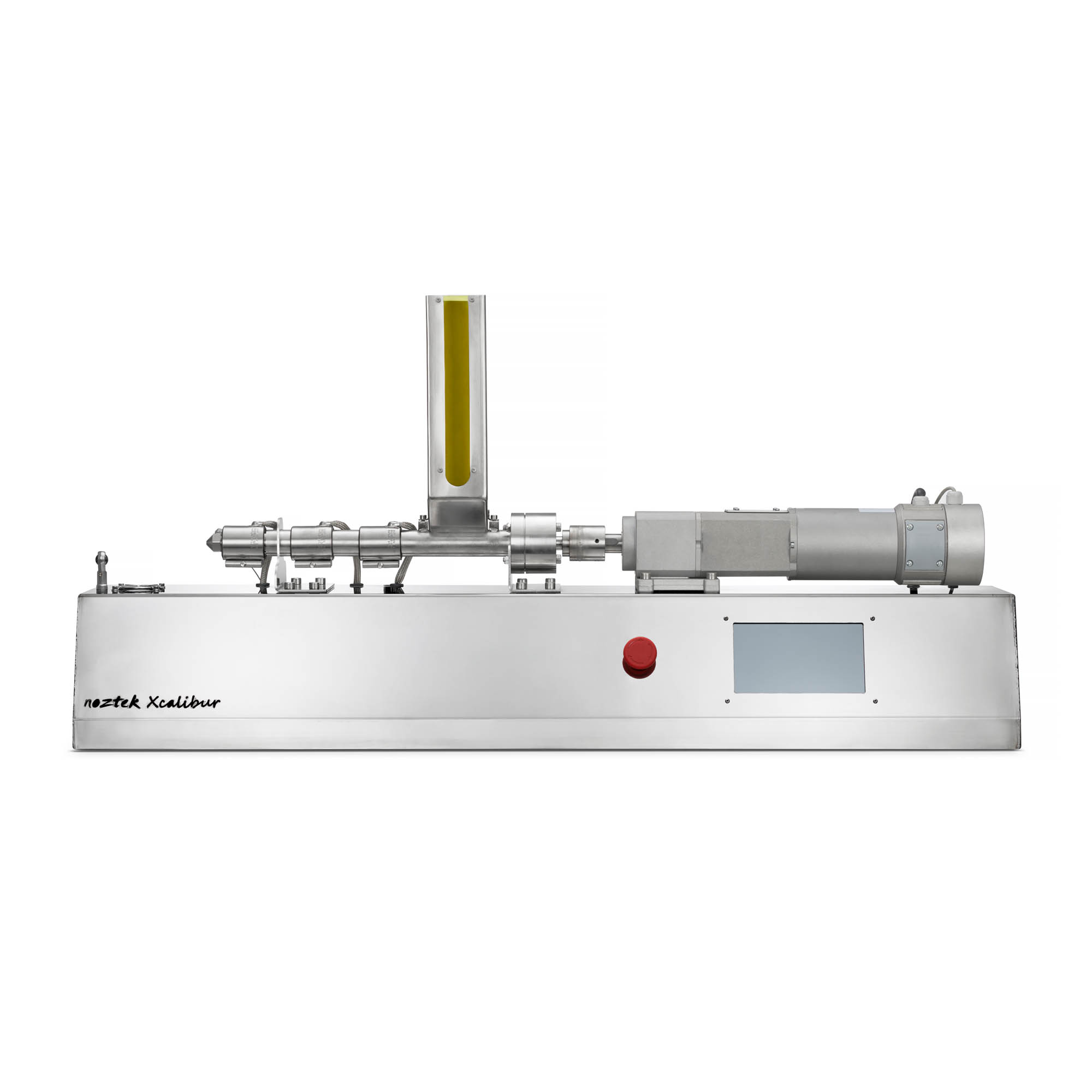
Revolutionary Mixing Screw Development: Raising the Bar on Dispersion
Screw geometry is the most underappreciated variable in filament extrusion. Noztek's latest mixing screw development programme addresses the dispersion limitations of conventional single-flight designs.
Why Screw Design Matters More Than You Think
Most discussions of filament extrusion quality focus on temperature control, motor precision, and die geometry. For composite and filled formulations — which represent a growing proportion of research and specialist filament production — the screw geometry is frequently the limiting factor in output quality.
A conventional single-flight conveying screw moves material from hopper to die efficiently, but provides limited dispersive and distributive mixing. For filled systems — carbon fibre, carbon black, clay nanocomposites, functional additives — the mixing action of the screw determines how well the filler is distributed through the matrix. Poor dispersion produces filament with property variation that undermines any downstream characterisation.
Dispersive vs Distributive Mixing
Dispersive mixing breaks up agglomerates — it applies high shear stress to separate filler particles or clusters that are physically or chemically bonded. Distributive mixing spreads the dispersed filler throughout the melt volume — ensuring that concentration is uniform across the filament cross-section and along its length. For most composite formulations, both are needed.
The New Mixing Screw Design
Noztek's mixing screw development programme targeted three specific limitations of conventional designs: insufficient dispersive mixing in the metering zone, inadequate distributive mixing before the die, and high sensitivity to feed rate variation in partially filled sections. The resulting geometry incorporates a modified Maddock-style mixing section followed by a distributive mixing element before the die adaptor.
Validation testing using carbon black-loaded PLA and short carbon fibre/PEEK systems demonstrated measurable improvements in electrical property uniformity and mechanical consistency compared to equivalent formulations processed on standard single-flight screws. The mixing screw is now available as standard on new machines and as an upgrade for the installed base.