Meet Your New Standard: The Noztek Nexus Series
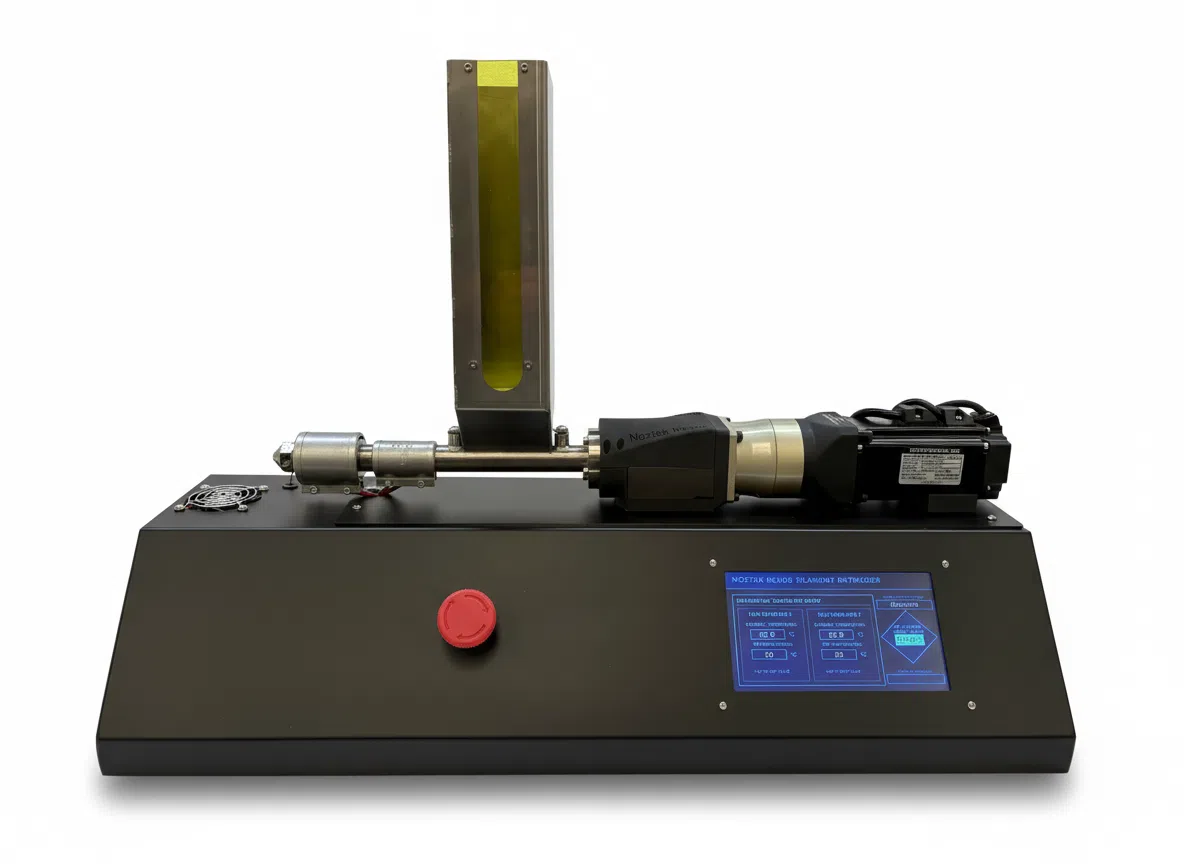
The Nexus series sets a new benchmark for desktop filament extrusion — combining industrial servo power, advanced control software, and modular design in a platform built for serious research.
A Platform, Not Just a Machine
The Nexus series represents a deliberate change in how Noztek approaches desktop extrusion. Rather than producing a single machine with a fixed capability set, we have developed a platform — a shared architecture of servo drive, thermal management, and control infrastructure — that can be configured and extended to match the requirements of specific research applications.
This platform approach matters because research requirements are not uniform. A pharmaceutical group investigating hot melt extrusion for modified-release dosage forms has different needs from a materials engineer developing carbon-fibre-reinforced composites. Both deserve equipment that genuinely fits their work rather than equipment that approximates it.
The Power Unit: Why Servo
Every machine in the Nexus series is built around a 750W closed-loop servo drive. This is not a cost-cutting substitution for earlier planetary DC motor systems, but a fundamental upgrade in capability. The servo maintains ±0.1% speed regulation across the full operating range — a figure that reflects genuine closed-loop control rather than the uncorrected output of an open-loop system.
For researchers, this translates directly to output consistency. Filament diameter variation — the most common quality issue in desktop extrusion — is substantially reduced when screw speed is held with this precision. Formulation-to-formulation reproducibility, a prerequisite for meaningful comparative research, becomes achievable.
Control and Monitoring Infrastructure
The Nexus control system was designed with research workflows in mind. All process variables — temperature across each barrel zone, screw speed, motor torque, and melt pressure — are monitored in real time and logged continuously. The process record for each run is complete and exportable, providing the data backbone for research that requires documented process traceability.
Modular by Design
The Nexus platform is designed to support downstream ancillaries as an integrated system. Water bath cooling, laser diameter gauging, puller and winder systems can all be connected to a common control architecture, allowing researchers to build an extrusion line that fits their specific requirements rather than accepting a fixed configuration.
This modularity also supports the transition from small-scale formulation work to pilot production. Start with a Nexus for single-kilogram research batches; add the Nexus RX when you need to scale output. The control interface, process logic, and data format are consistent across both, so process knowledge translates directly.
The Nexus Family
The Nexus series currently comprises the Nexus — the core desktop research extruder — and the Nexus RX, which extends the platform to large-format production capability. Further configurations are under development. All share the same servo architecture, control platform, and design philosophy: that serious research requires serious equipment, and that serious equipment should be accessible to the laboratory rather than the factory floor.