
PCB and Electronics Innovations in Extrusion Control Systems
A look at the electronics architecture behind Noztek's latest generation of control systems — custom PCB design, sensor integration, and the firmware decisions that enable real-time process monitoring.
Why Electronics Matter in Extrusion
An extrusion machine is fundamentally a mechatronic system — its performance depends equally on the mechanical design and the electronics and software that control it. A precision barrel with excellent thermal mass is only as good as the control system maintaining it at setpoint. Noztek's move to custom electronics design reflects the recognition that the performance requirements of precision extrusion exceed what general-purpose control hardware can reliably deliver.
Custom PCB Architecture
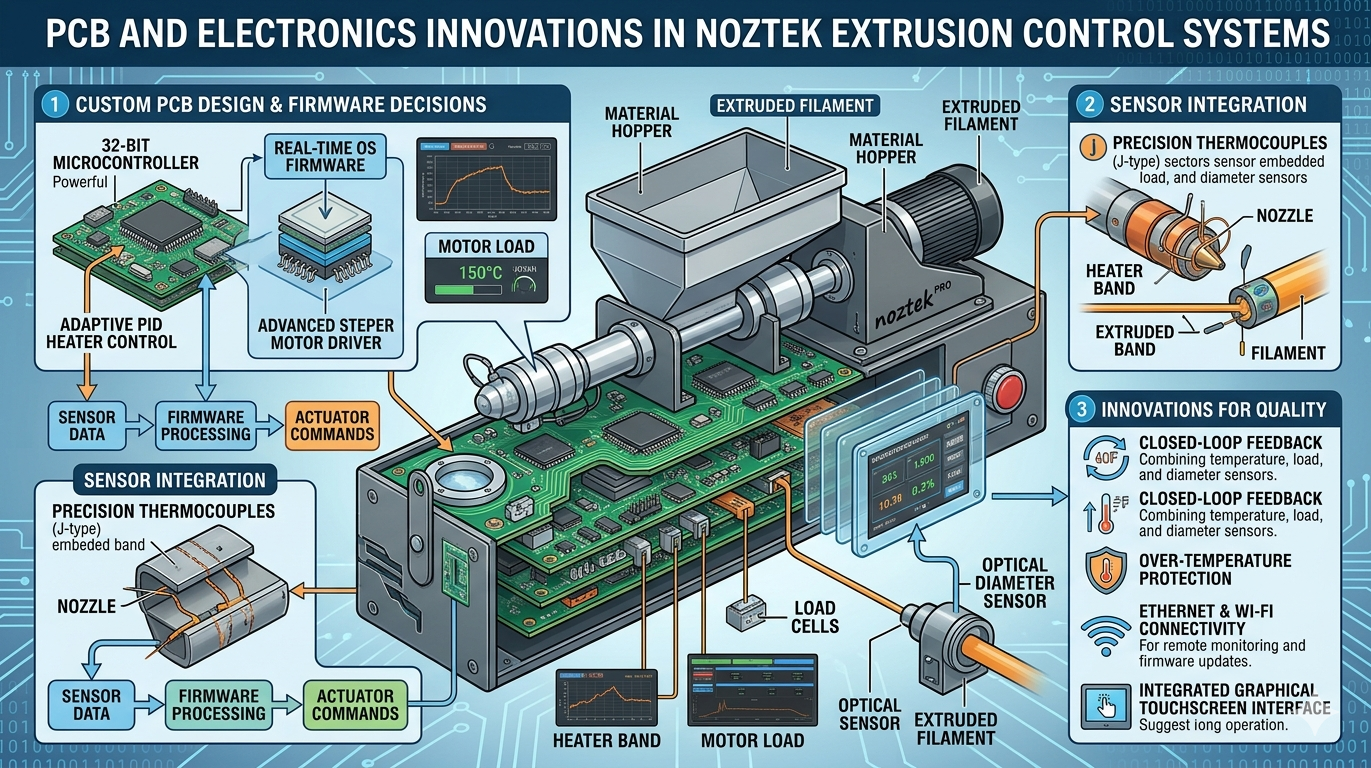
The control PCB in current Noztek machines is a custom design developed specifically for extrusion control applications. Key design decisions include: isolated measurement circuits for thermocouple signals to eliminate common-mode interference from high-current heater circuits; dedicated servo amplifier integration; and sufficient analogue-to-digital conversion resolution for torque and temperature measurements. Standard off-the-shelf microcontroller boards lack the isolation required for reliable thermocouple measurement in close proximity to 1–2kW heater circuits.
Sensor Integration
The measurement capability available from current Noztek machines — screw speed, multi-zone temperature, motor torque, and optionally melt pressure — requires careful sensor selection and integration. Each sensor type has different electrical characteristics, noise sources, and calibration requirements. The PCB design accommodates all of these within a single compact board that also handles motor drive, power management, and communication interfaces.
The result is a system that provides research-grade measurement capability in a machine that occupies a laboratory bench — supporting the kind of quantitative process analysis previously only available on industrial equipment with dedicated data acquisition systems.