
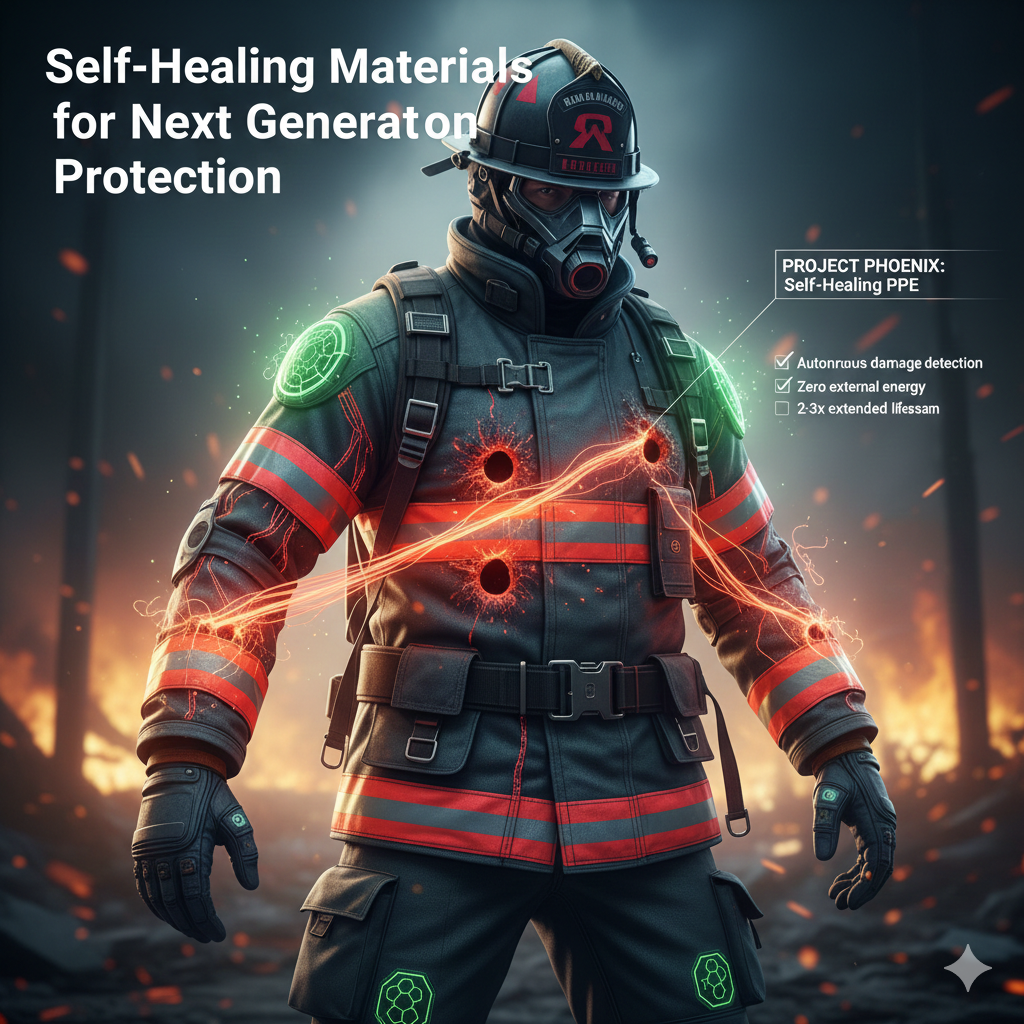
Project PHOENIX: Self-Healing Materials for Firefighter Protection
How 4D polymer science could transform next-generation PPE — self-healing composites that repair impact damage autonomously, extending equipment lifespan and improving safety for frontline firefighters.
The Problem With Current PPE Materials
Structural firefighting gear operates in some of the most hostile environments that materials science must contend with. Helmets, face shields, and load-bearing components absorb repeated thermal and mechanical shocks over their service life. Current materials — typically glass-fibre composites and polycarbonate blends — perform exceptionally well in isolation, but accumulate micro-damage that is effectively invisible to inspection.
This is the core problem: a helmet that has taken significant impact loading may appear structurally sound while its internal fibre architecture has been compromised in ways that dramatically reduce its protective capability. Replacement schedules address this partially, but they are blunt instruments that either retire functional equipment prematurely or allow genuinely compromised equipment to remain in service.
Self-Healing Polymers: The Mechanism
Self-healing materials are not a theoretical concept. Several material classes are now well-characterised at laboratory scale, with different mechanisms suited to different damage types. For structural PPE applications, the most relevant approaches involve encapsulated healing agents within the polymer matrix.
In the most studied microencapsulation approach, the matrix material contains microcapsules filled with a liquid monomer and a separate catalyst. When a crack propagates through the material, it ruptures the capsules, releasing the healing agent into the damage zone. Polymerisation begins on contact with the catalyst, bonding the crack faces and partially restoring structural integrity.
The 4D Manufacturing Connection
4D printing — the fabrication of structures whose geometry or properties change over time in response to stimuli — provides a manufacturing pathway for self-healing composites that conventional processing cannot easily replicate. By incorporating shape-memory polymers alongside the healing agent system, it becomes possible to engineer materials that not only close cracks but actively pull damage sites together as part of the healing response.
Desktop hot-melt extrusion plays a critical role in this development pipeline. Producing filament from custom polymer blends incorporating microencapsulated healing agents, shape-memory components, and structural reinforcement fibres requires precise, controlled processing — particularly around melt temperature and residence time, both of which affect capsule integrity and healing agent viability.
Challenges Still to Solve
The path from laboratory characterisation to certified PPE is substantial. Current self-healing composites restore a significant fraction of original tensile strength — typically 70–90% depending on the system and damage severity — but this falls short of the requirements for primary protective structures. Healing kinetics at operational temperatures, the number of effective repair cycles, and the interaction of healing systems with flame-retardant additives are all active research questions.
- Healing efficiency under thermal load (firefighting environments reach well above ambient)
- Compatibility of encapsulated agents with FR additive packages
- Long-term stability of microcapsules over the service life of the equipment
- Certification pathways for novel materials in safety-critical applications
Why This Research Matters
The firefighting community worldwide deals with PPE failure as a statistical reality. Self-healing materials will not eliminate this, but they have the potential to shift the failure curve meaningfully — extending safe service life, providing a degree of autonomous damage response, and ultimately improving the protection available to people operating in the most demanding conditions imaginable.
Project PHOENIX represents a long-horizon research direction for Noztek. The materials processing challenges involved — producing consistent, research-quality filament from complex multi-component formulations — sit directly within what our equipment is designed to enable. We will continue to share progress as the programme develops.