
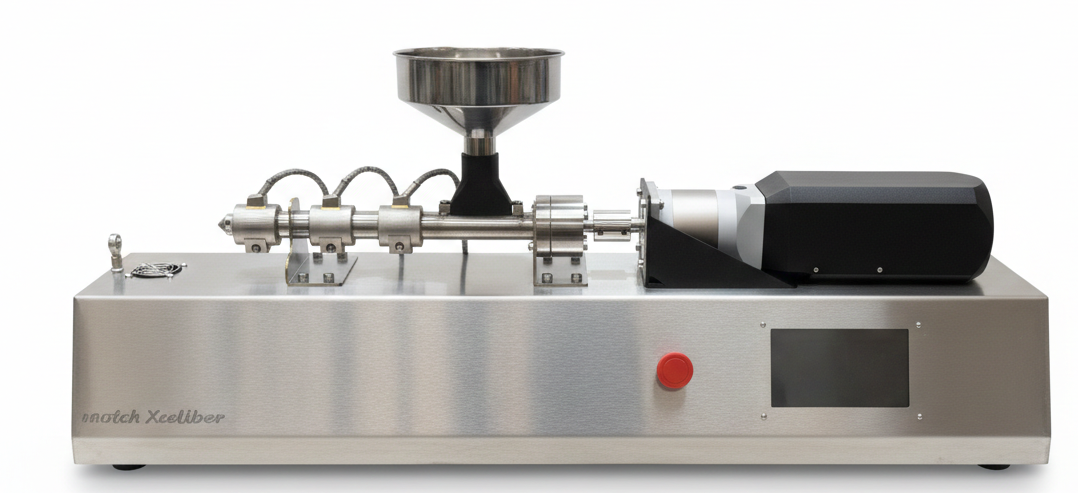
The New Servo-Powered Xcalibur
The Xcalibur Servo replaces conventional open-loop DC motors with a 750W closed-loop servo system — delivering ±0.1% speed regulation, real-time torque monitoring, 600°C processing capability, and a 5-litre stainless steel hopper. A ground-up redesign for researchers working at the boundaries of polymer processing.
The Case for Servo Control
For years, the standard approach to desktop filament extrusion used open-loop DC motor systems. They were reliable, cost-effective, and adequate for commodity polymers. But as researchers began pushing into high-performance thermoplastics — PEEK, PEI, PEKK, carbon-fibre-loaded compounds — the limitations became impossible to ignore.
Open-loop systems have no feedback mechanism. When melt viscosity increases, when the hopper charge changes, when ambient temperature fluctuates — the motor simply responds with whatever torque it was set to deliver. Screw speed drifts. Filament diameter varies. Repeatability suffers. For research-grade work, this isn't acceptable.
The Xcalibur Servo addresses this directly. By replacing the DC drive with a 750W closed-loop servo system, the extruder gains the ability to monitor, correct, and maintain screw speed in real time — regardless of what the melt is doing.
What 750W Means in Practice
Raw wattage is only part of the story. The servo architecture provides something more valuable: constant torque across the full operating speed range. Where a DC motor will lose torque as back-pressure increases, the servo maintains output. This matters enormously when processing high-viscosity melts or fibre-loaded compounds that place unpredictable demands on the screw.
The result is ±0.1% speed regulation — a figure that makes the Xcalibur Servo competitive with systems costing significantly more. Real-time torque monitoring means researchers can observe melt behaviour as it happens, identifying viscosity transitions, processing windows, and formulation anomalies without post-process analysis.
Built for Extreme Processing
The thermal specification of the Xcalibur Servo reflects its intended use case. With barrel temperatures up to 600°C, the system can process the full spectrum of engineering thermoplastics — including ultra-high-performance polymers that have historically required industrial-scale equipment.
The stainless steel construction throughout reflects not just durability, but chemical resistance — important when processing compounds that may interact aggressively with lower-grade alloys at elevated temperatures.
Key Specifications
| Parameter | Specification |
|---|---|
| Motor | 750W closed-loop servo |
| Speed regulation | ±0.1% |
| Max barrel temperature | 600°C |
| Hopper capacity | 5 litres (stainless steel) |
| Monitoring | Real-time torque, temperature, screw speed |
Who This Machine Is For
The Xcalibur Servo is designed for materials researchers, polymer engineers, and R&D laboratories that require genuine precision rather than approximate control. If your work involves custom formulations, high-performance thermoplastics, or fibre-reinforced compounds, the variable performance of open-loop systems will consistently undermine your results.
For those working at the boundaries of what desktop extrusion can achieve — processing temperatures, material classes, formulation complexity — the Xcalibur Servo provides a platform that can keep pace. This is the machine for work that cannot afford compromises.